


Renovating a Home on the Vancouver Heritage Register involves more than a standard renovation. Many homeowners either assume heritage status prevents almost any change or believe it carries little real impact. In reality, the rules depend on your property’s level of protection, its character-defining elements, and whether your project affects protected features. Understanding these requirements before design and permitting begin can help you avoid costly delays, permit issues, and revisions later in the process.
What Does It Mean When Renovating a Home on the Vancouver Heritage Register?
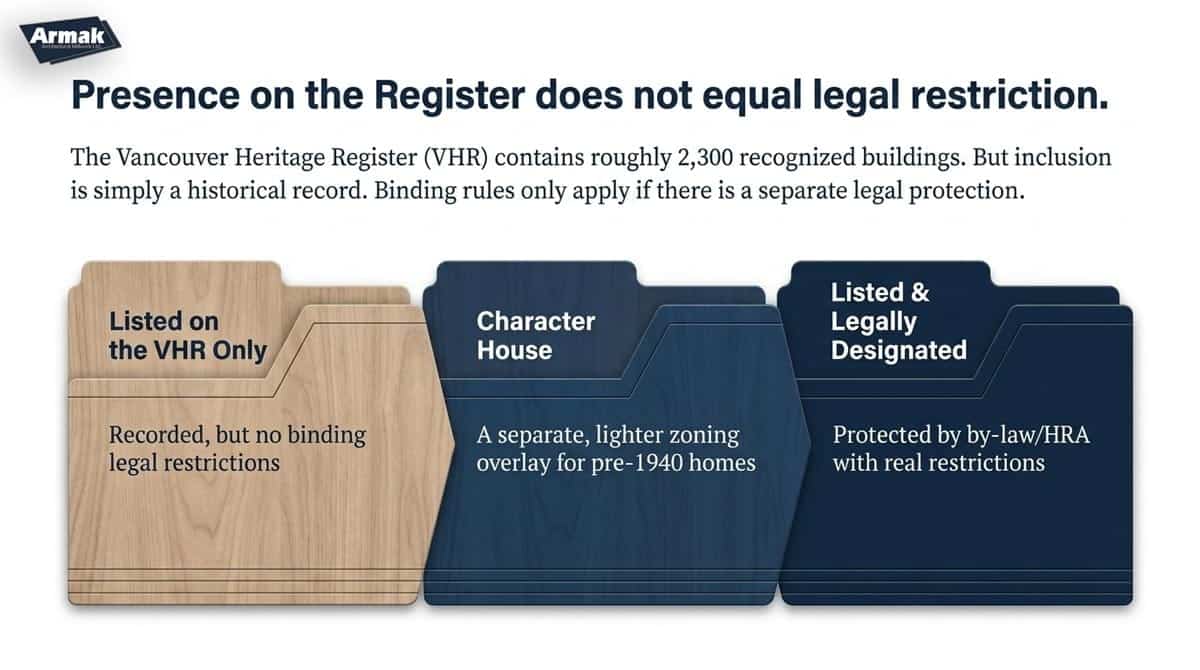
When Renovating a Home on the Vancouver Heritage Register, understanding the difference between a listing and a legal designation is essential.
The Vancouver Heritage Register, or VHR, is the City’s official list of roughly 2,300 buildings recognized for their heritage value. Being on it means your home is documented as significant, but it doesn’t automatically mean strict rules apply.
That depends on a separate distinction most people miss: a VHR listing is just a record. Legal protection is a different, more binding status. Your home could be in any of three situations:
- Listed on the VHR only: recorded, but no binding legal restrictions yet
- Listed and legally designated: protected by a by-law or Heritage Revitalization Agreement, with real restrictions
- Not on the VHR, but a Character House: a separate, lighter zoning overlay that applies to most pre-1940 homes
Checking which one applies takes a few minutes through the City’s VHR address search or the Vancouver Heritage Foundation’s Heritage Site Finder. A notation like “M” on your listing means legal designation, not just a historical note on file.
The Different Levels of Heritage Protection: Then and Now
If you’ve read about Vancouver heritage homes anywhere else, you’ve probably seen references to Category A and Category B buildings. That system is gone. The City retired its old A, B, and C grading scale on October 8, 2024, replacing it with a values-based evaluation that no longer ranks buildings by a letter grade at all.
Here’s what changed and what stayed the same:
| Before October 2024 | Now | |
|---|---|---|
| How buildings were ranked | A (most significant), B (significant), C (contextual) | No letter grading; evaluated on documented heritage value instead |
| What determined protection | Category often implied protection level | Protection comes only from a separate legal designation, not the VHR listing itself |
| Basis for evaluation | Mostly architectural and historical merit | Tangible and intangible heritage, including cultural traditions and lived experience |
The practical takeaway matters more than the history lesson. Whether or not your home was once an “A” or “B” building, that letter never told you the full story anyway. The City has always been clear that a property’s actual legal protection depends on separate designation notations, not its old category. You’ll still see properties on the current Register marked with codes such as M for municipal designation, I for protected interior features, L for protected landscape elements, or HC for a registered heritage conservation covenant. These notations, not the retired letter grades, are what determine whether you need a Heritage Alteration Permit before touching your home.
So if a contractor or article tells you your “Category A” status means automatic strict rules, ask instead whether your property carries a legal designation notation. That’s the question that actually decides what you can and can’t do.
What Is Legally Protected: Character-Defining Elements
One of the most important aspects of Renovating a Home on the Vancouver Heritage Register is understanding which character-defining elements are legally protected. These are the physical features the City has identified as the reason your home has heritage value in the first place, and they’re what a Heritage Alteration Permit is actually designed to protect. Touch one of these without approval, and you’re not dealing with a building inspector’s note, you’re dealing with a stop-work order.
The most commonly protected elements on Vancouver heritage homes include:
- Original windows: not just the glass, but the muntin profile, the sash operation (double-hung versus casement), and even the slight waviness of old glass that machine-made replacements can’t replicate
- Exterior cladding: clapboard, shingle, or board-and-batten siding in its original material and exposure width
- Roofline and pitch: including dormers, eave depth, and any decorative bargeboard or bracket detail
- Front porch elements: columns, railings, and the proportions of the structure as a whole
- Decorative millwork: corbels, fascia trim, window casings, and entry surrounds that define the home’s architectural style
- Select interior features, where the designation specifically extends inside: staircases, fireplace mantels, wainscoting, and original built-ins are the most frequently flagged
This is where matching gets expensive. Custom millwork cut to century-old profiles, sourced old-growth lumber, hand-detailed casings, takes a different skill set than a standard renovation shop offers. Worth confirming your contractor has handled designated heritage properties specifically, not just character homes, before signing off on the work.
What You Can Actually Change Without Losing Heritage Status
This is the part homeowners actually want to hear, and it’s better news than most expect. Heritage protection in Vancouver is mostly about the exterior, what passersby and City planners can see from the street. Behind the front facade, most VHR-listed homes give you nearly as much freedom as a standard renovation.
A full kitchen rebuild, a bathroom renovation, or an open concept conversion of the main floor can usually proceed under standard building permits, no Heritage Commission involved, as long as nothing touches a protected exterior wall or a flagged interior feature.
| Generally unrestricted | Generally restricted | |
|---|---|---|
| Kitchen | Layout, cabinetry, appliances, island placement | Original built-in cabinetry, if flagged as a character element |
| Bathroom | Fixtures, tile, layout, plumbing relocation | Original clawfoot tubs or fixtures, if specifically protected |
| Living spaces | Wall removal, open layouts, flooring | Original millwork, staircases, mantels in “I”-designated homes |
| Systems | Electrical, plumbing, HVAC, insulation | None typically, even in fully designated properties |
One exception worth flagging: a smaller subset of properties carry an interior designation, marked with an “I” notation. There, specific rooms or features, often an entry hall or original wood paneling, are legally protected the same way a facade would be. Outside those flagged rooms, the rest of the interior is fair game.
Structural changes still need an engineer’s sign-off and a standard building permit, the same requirement any open concept renovation in Metro Vancouver faces regardless of the home’s age. Heritage status doesn’t add a second layer of review here unless the wall happens to be part of a protected feature, which is rare.
Where things get trickier is when a renovation quietly crosses from interior to exterior, swapping a kitchen window for a larger one, say, or adding a skylight that changes the roofline from the street. Worth flagging with a contractor before drawings are finalized, not after a permit gets kicked back.
The Heritage Alteration Permit (HAP) Process Explained
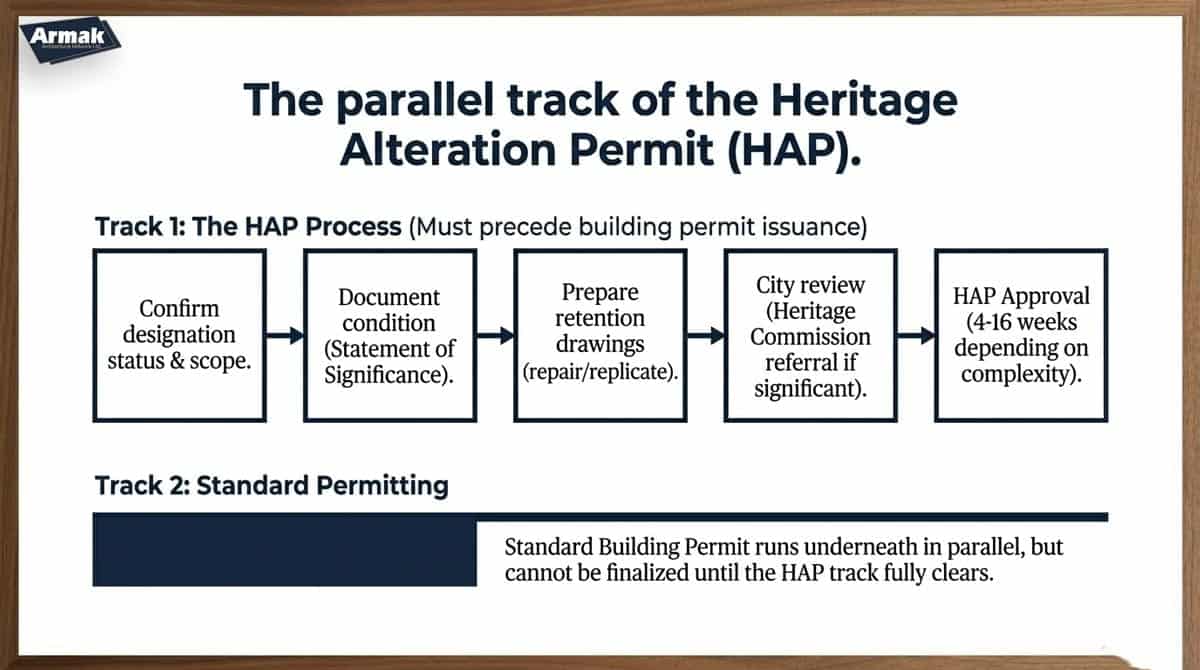
For many homeowners, Renovating a Home on the Vancouver Heritage Register involves obtaining a Heritage Alteration Permit (HAP) before construction can proceed. It runs alongside your regular permit process, and it’s usually what determines your overall timeline.
The process generally follows five stages:
- Confirm your status and scope. Find out whether your property carries legal designation and which elements are flagged, before any drawings exist.
- Document the existing character. Most applications need a Statement of Significance describing the protected elements and their condition, usually prepared by a heritage consultant.
- Prepare drawings showing retention. Site plans and elevations need to show how protected elements will be retained, repaired, or replicated, not just what’s being proposed.
- Submit for review. City heritage staff assess the application. Straightforward requests move faster; significant changes may get referred to the Vancouver Heritage Commission.
- Receive approval and proceed to building permit. Once the HAP is issued, the standard building permit process runs its normal course.
Timelines vary by scope. A straightforward repair might clear review in four to eight weeks. Anything needing Commission referral, additions, demolition, major exterior changes, typically runs eight to sixteen weeks, with City fees running several hundred dollars on top of standard permit costs before consultant and drawing fees.
The biggest predictor of a smooth approval isn’t the scope of work, it’s whether the application clearly shows protected elements are being respected rather than replaced.
How Much Does a Heritage Renovation Cost Compared to a Standard Renovation?
The cost of Renovating a Home on the Vancouver Heritage Register is typically higher than a comparable renovation on a non-heritage property.
Where the extra money actually goes:
| Cost driver | Why it adds up |
|---|---|
| Heritage consultant fees | Statement of Significance, condition documentation, design review support |
| Custom millwork and materials | Matching century-old profiles requires specialist fabrication, not stock products |
| Specialist trades | Heritage carpenters, plasterers, and window restorers charge premium rates and are in limited supply |
| Extended permit timelines | Heritage Commission review can add 6 to 12 weeks of carrying costs on financing |
| Hidden conditions | Older construction frequently reveals knob-and-tube wiring, rubble foundations, or asbestos once walls open up |
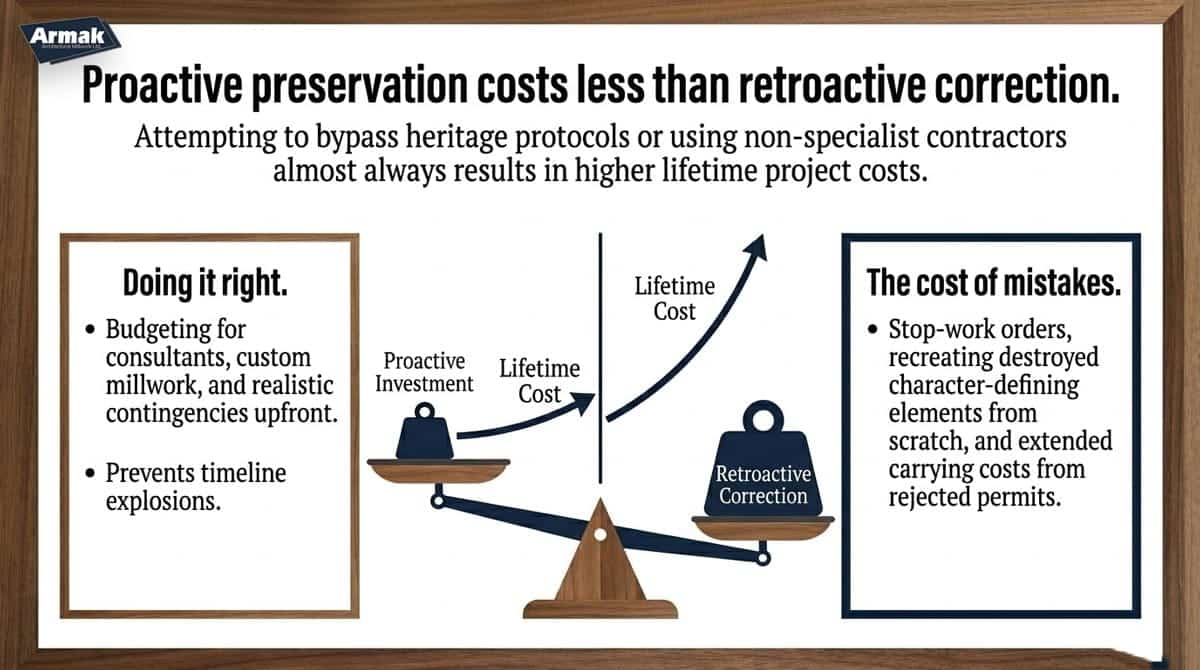
A kitchen renovation cost in Vancouver already varies widely by finish level, but heritage status adds its own layer on top of that baseline, mostly through the custom millwork and consultant fees above rather than the kitchen itself. The same applies to bathroom work: retiling a bathroom in a heritage home costs roughly the same per square foot as a standard project, unless the fixtures themselves, a clawfoot tub or original tile pattern, happen to be protected.
It’s worth comparing this premium against the alternative. Recreating lost character-defining elements after the fact, once damage has already occurred or a previous renovation stripped them out, almost always costs more than preserving them properly the first time. Budgeting realistically from the start, including a contingency for what gets discovered once walls open up, tends to save money over the life of the project rather than cost it.
Conclusion
Renovating a Home on the Vancouver Heritage Register comes down to understanding what is protected, what can be changed, and how the permit process affects your project. Once you’ve confirmed your property’s real status, separate from outdated category labels or assumptions, most of the renovation freedom homeowners want is still on the table. The exterior deserves careful, well-documented planning. The interior, in most cases, doesn’t need to hold you back at all.


