


Kitchen renovation costs in Vancouver vary widely, and without a clear picture of what drives those numbers, it’s easy to either overspend or end up with a result that doesn’t match your expectations. In this guide, we break down the real costs across three budget tiers, Budget, Mid-Range, and High-End, so you can plan with confidence. And if you’re ready to move forward, the team at Armak Millwork is here to help you get it right from the start.
Average Kitchen Renovation Cost in Vancouver (2026 Overview)
Kitchen renovation costs in Vancouver typically fall between $25,000 and $200,000. That range isn’t vague. It reflects genuinely different scopes of work, material quality, and labour complexity.
| Renovation Tier | Cost Range | Scope |
| Budget | $25,000 – $50,000 | Cosmetic updates, stock cabinets, minimal layout changes |
| Mid-Range | $30,000 – $75,000 | Full renovation, semi-custom cabinetry, layout optimization |
| High-End | $75,000 – $150,000+ | Custom millwork, structural changes, premium finishes |
Even within each tier, costs can shift significantly. Moving a sink, relocating a gas line, or opening up a wall adds $8,000 to $20,000 to any project. Condo renovations carry extra costs too, strata approvals, restricted work hours, and waste disposal logistics all add up. One important note for 2026: import tariffs on U.S.-manufactured cabinets and metals, combined with a weaker Canadian dollar, have pushed material costs up by roughly 10 to 15 percent compared to 2024. Budget accordingly.
Budget Kitchen Renovation in Vancouver ($25,000 – $50,000)
This tier covers a full cosmetic refresh without touching the bones of the kitchen. You’re working with the existing layout, keeping plumbing and electrical where they are, and focusing the budget on surfaces and finishes.
What You Actually Get
At this price point, expect stock or entry-level semi-custom cabinets, laminate or basic quartz countertops, standard fixtures, and updated lighting. Appliances are typically builder-grade or mid-range brands like Samsung or LG. Flooring is usually luxury vinyl plank or ceramic tile. What you won’t get is flexibility. Stock cabinets come in fixed sizes, and in older Vancouver homes or condos with non-standard dimensions, that mismatch can create filler gaps and awkward corners that no amount of trim work fully hides.
Cabinetry & Millwork at This Level
This is where budget renovations vary most in quality. The difference between a $28,000 and a $42,000 budget kitchen often comes down entirely to cabinetry choice.
- Stock cabinets ($5,000–$12,000): Pre-built, limited sizes, faster lead times. Fine for straightforward layouts.
- Semi-custom cabinets ($10,000–$20,000): More size flexibility, better finishes, still cost-effective.
- Cabinet refacing ($5,000–$13,000): If your existing cabinet boxes are structurally solid, refacing the doors and drawer fronts delivers a dramatic visual change at a fraction of replacement cost. This is one of the smartest moves at this budget tier.
As for custom millwork at this level, it’s rarely justified across the whole kitchen. But investing in one or two custom pieces, a built-in pantry, a custom island, or a specific corner solution, can solve a real functional problem without blowing the budget.
Who Is This For?
- Rental property owners looking to modernize without overcapitalizing
- Condo owners preparing for resale in the entry-to-mid market
- Homeowners doing a style refresh while keeping a functional layout they’re happy with
Limitations to Understand Before You Commit
Going in with clear expectations at this tier matters. A few honest realities:
- Layout stays as-is. Moving the sink, island, or major appliances pushes costs into mid-range territory immediately.
- Material longevity is shorter. Laminate countertops and stock cabinet finishes show wear faster than higher-grade alternatives.
- Resale appeal is moderate. In Vancouver’s competitive real estate market, a budget renovation reads as a budget renovation to buyers. It’s better than outdated, but it won’t command a premium offer.

Mid-Range Kitchen Renovation in Vancouver ($30,000 – $75,000)
This is where most Vancouver homeowners end up, and honestly, it’s the tier that makes the most sense for the majority of projects. Enough budget to do things properly, without tipping into luxury territory that the neighbourhood can’t support.
If you want to know which styles and materials are most popular this year, check out our guide on Top Kitchen Renovation Trends in Metro Vancouver: 2026.
The Most Popular Choice in Vancouver, Why?
Most Vancouver homeowners renovating for resale or long-term enjoyment land in this tier. It’s the point where the kitchen stops feeling like a compromise. You get real design flexibility, meaningful material upgrades, and enough budget to solve functional problems that a cosmetic refresh can’t touch.
What Changes Compared to Budget?
The gap between a $38,000 and a $60,000 kitchen isn’t just aesthetics. It’s a fundamentally different project:
- Layout changes become possible. Minor plumbing relocations, island additions, and opening sightlines to adjacent rooms are realistic at this budget.
- Semi-custom cabinetry replaces stock, giving you proper sizing for your space and significantly better construction quality.
- Quartz countertops become the standard rather than the upgrade. Brands like Caesarstone and Silestone are widely expected by Vancouver buyers in this price range.
- Appliance packages step up to mid-range brands like Bosch, Fisher & Paykel, or KitchenAid.
- Lighting and electrical get proper attention: pot lights, under-cabinet strips, and dedicated circuits for modern appliances.
Cabinetry & Millwork at Mid-Range: Where the Biggest Gains Are
At this tier, selectively incorporating custom millwork elements alongside semi-custom cabinets delivers outsized results. A full-height pantry wall, custom range hood surround, or built-in integrated storage is both achievable and highly effective within this budget. In Vancouver’s typically compact kitchen footprints, smart millwork does more for daily livability than almost any other line item.
Real Vancouver Scenario
A typical mid-range project involves a 120 to 180 sq ft kitchen, a minor layout adjustment, semi-custom cabinetry, quartz countertops, tile backsplash, and a full appliance package. From design sign-off to completion, expect 10 to 16 weeks total. For condos, add 2 to 4 weeks for strata approvals and logistics.
A typical mid-range kitchen renovation in Vancouver takes 10 to 16 weeks. For a detailed breakdown of each phase, read our article on Kitchen Renovation Timeline in Metro Vancouver.
ROI of Mid-Range
- Returns 75 to 100 percent of cost at resale in Metro Vancouver
- Updated kitchens at this tier attract stronger offers and sell faster
- Best ROI match is homes priced between $900,000 and $2,000,000
- Overcapitalizing in lower-value neighbourhoods reduces returns significantly
High-End Kitchen Renovation in Vancouver ($75K–$150K+)
High-end Kitchen Renovation Cost in Vancouver go far beyond surface upgrades. At this level, the focus is on full redesign, custom-built elements, and seamless integration with the rest of the home. Most projects involve layout changes, structural work, and fully customized millwork built specifically for the space.
Luxury Expectations in the Vancouver Market
In this price range, kitchens are expected to feel architectural rather than “renovated.” Typical features include:
- Custom millwork designed for the full space
- Waterfall islands using premium stone
- Fully integrated appliances (hidden behind panels)
- Multi-layer lighting design
Waterfall islands and built-in appliances are no longer upgrades here. They are the baseline expectation in most high-end Vancouver homes. Lighting also plays a more intentional role. Instead of just brightness, the goal is depth, contrast, and highlighting materials like stone and wood.
Custom Millwork | Where the Real Investment Is
Custom millwork is usually the most expensive part of a high-end Kitchen Renovation Cost in Vancouver. In most Vancouver projects, it accounts for 40% to 50% of the total budget. Why it costs more:
- Built specifically for the exact space
- No standard sizing or stock components
- Fully tailored internal storage systems
- Premium finishing and detailing
Materials commonly used:
- Solid wood (structural frames)
- Veneer (consistent visual finish)
- Lacquer (smooth modern surfaces)
- Integrated LED lighting in cabinets and shelves
A typical workflow with a millwork specialist includes:
- Design consultation and layout planning
- 3D modeling and approvals
- Shop drawings and material selection
- Fabrication (8–14+ weeks)
- On-site installation and adjustments
Lead time is often one of the biggest planning factors in this tier.
Where the Money Actually Goes
High-end budgets are distributed quite differently compared to mid-range projects.
| Component | Share of Budget |
| Cabinetry & Millwork | 40–50% |
| Structural Changes | 10–20% |
| Design & Engineering | 10–15% |
| Appliances | 10–20% |
| Plumbing & Electrical | 8–15% |
| Permits & Approvals | 5–12% |
Structural work becomes more common at this level, especially in older Vancouver homes where walls are removed or layouts are completely reconfigured. Design and permitting are also more complex, particularly when working with city regulations and load-bearing modifications.
Who Chooses This Tier
High-end Kitchen Renovation Cost in Vancouver are usually chosen by homeowners who plan to stay in the property long term and want the kitchen to match the overall architecture and lifestyle of the home. This tier is common in West Vancouver luxury homes and in Kitsilano properties undergoing full open-concept remodels, where the kitchen becomes the main design feature of the entire living space rather than just a functional area.
Cost Breakdown by Component (All Tiers)
Understanding where the budget actually goes helps you see why Kitchen Renovation Cost in Vancouver vary so widely. Even when two projects look similar on the surface, the internal cost structure can be very different depending on material choices, labour intensity, and design complexity.
Component Cost Comparison
| Component | Budget | Mid-Range | High-End |
| Cabinetry & Millwork | 30% | 35% | 40–50% |
| Labour | 25–30% | 25–30% | 20–25% |
| Countertops | 10–15% | 12–18% | 15–20% |
| Appliances | 10–15% | 12–15% | 10–20% |
| Plumbing / Electrical | 8–12% | 8–12% | 8–15% |
| Permits & Design | 3–5% | 5–10% | 8–12% |
What These Numbers Actually Mean
Cabinetry and millwork take the largest share in every tier, with the biggest jump in high-end projects coming from full customization rather than just better materials. Labour stays fairly consistent, but its percentage drops in luxury renovations because materials and design complexity increase faster than installation work. Countertops and appliances scale with quality and integration, especially in high-end kitchens with waterfall stone and built-in systems. Permits and design costs rise when structural changes are involved, which is common in older Vancouver homes and condo renovations.
What Affects Kitchen Renovation Cost in Vancouver?
Kitchen Renovation Cost in Vancouver are influenced by more than just materials and design. Local labour rates, building regulations, and even logistics inside condos can significantly change the final budget. Understanding these factors helps explain why two similar kitchens can end up with very different total costs.
Labour Costs in Metro Vancouver
Labour is one of the biggest cost drivers in the region.
- Skilled trades (electricians, plumbers, installers) are in high demand
- Rates are higher compared to many other Canadian cities
- Complex layouts or older homes increase labour hours
Even small changes like moving plumbing or adding new electrical circuits can noticeably increase the total cost.
Building Permits & Vancouver Code Requirements
In Vancouver, most Kitchen Renovation Cost in Vancouver that go beyond simple cosmetic updates require permits, especially when structural, electrical, or plumbing changes are involved. The city has strict building codes focused on safety, ventilation, and energy efficiency, and inspections are typically required at different stages of the project, which can affect both timeline and cost.
Condo vs. House: A Different Beast Entirely
Condo renovations in Vancouver come with extra layers of restriction. Common limitations include:
- Strata approval before work begins
- Restricted working hours (noise control rules)
- Elevator booking for material delivery
- Limited waste removal access
In contrast, houses offer more flexibility, faster execution, and fewer logistical delays.
Seismic & Moisture Considerations | Vancouver-Specific
Because of Vancouver’s coastal climate and seismic activity requirements, Kitchen Renovation Cost in Vancouver often need extra attention to moisture control, ventilation, and structural stability. Older homes in particular may require additional reinforcement and updated building practices to ensure long-term durability and compliance with local standards.
Material Costs & Import Tariffs in 2025–2026
Material pricing in Vancouver is influenced by global supply chains. Main factors:
- Import tariffs on U.S.-sourced cabinets and metals
- Fluctuations in the Canadian dollar
- Increased shipping and supplier costs
As a result, material prices in 2026 are generally higher than previous years, especially for custom cabinetry and premium finishes.
Budget vs Mid-Range vs High-End: Which One Is Right for You?
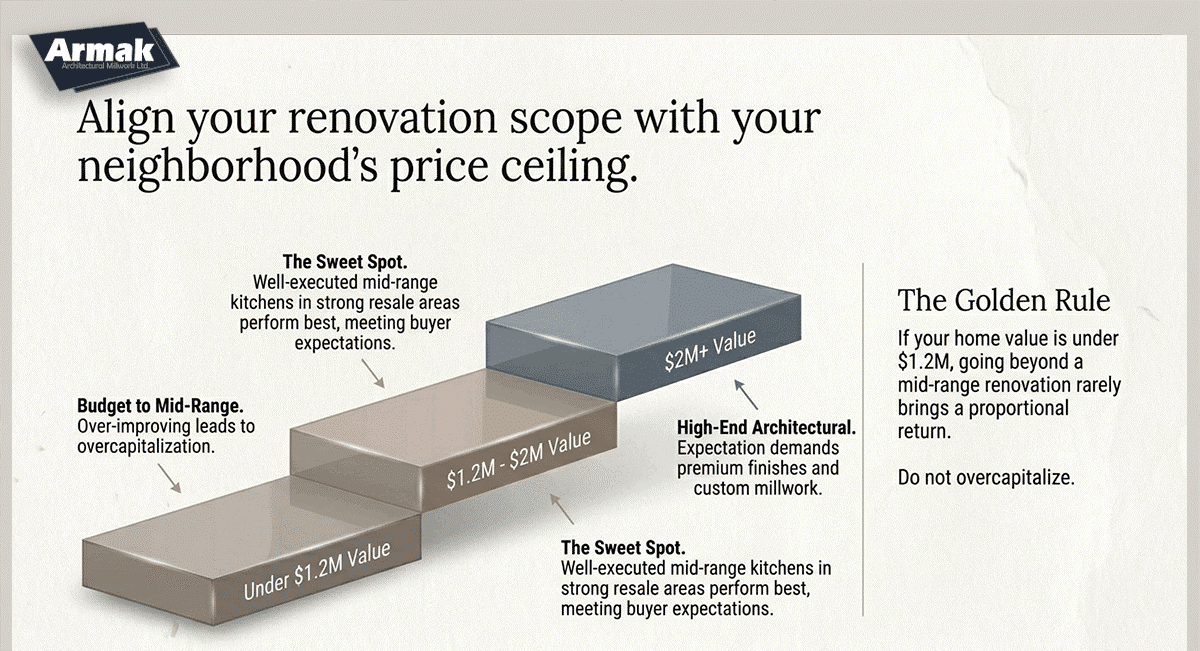
Choosing the right renovation tier in Vancouver is less about preference and more about financial alignment with your property value and goals. Each level serves a different purpose, and selecting the wrong one can either limit your return or lead to unnecessary overspending.
Quick Decision Guide
- Resale value focus → Mid-Range
- Rental property ROI → Budget
- Lifestyle upgrade → High-End
- Condo sale preparation → Budget to Mid-Range
How to Match Budget With Property Value?
If your home value is under $1.2M, going beyond a mid-range renovation often does not bring proportional return in Vancouver’s market. Over-improving a property in a lower price bracket can lead to overcapitalization, where the renovation cost exceeds what buyers are willing to pay. A better approach is to align your renovation scope with the neighbourhood ceiling. In many cases, a well-executed mid-range kitchen delivers the strongest balance between daily comfort and resale performance.
How to Reduce Kitchen Renovation Cost in Vancouver Without Sacrificing Quality?
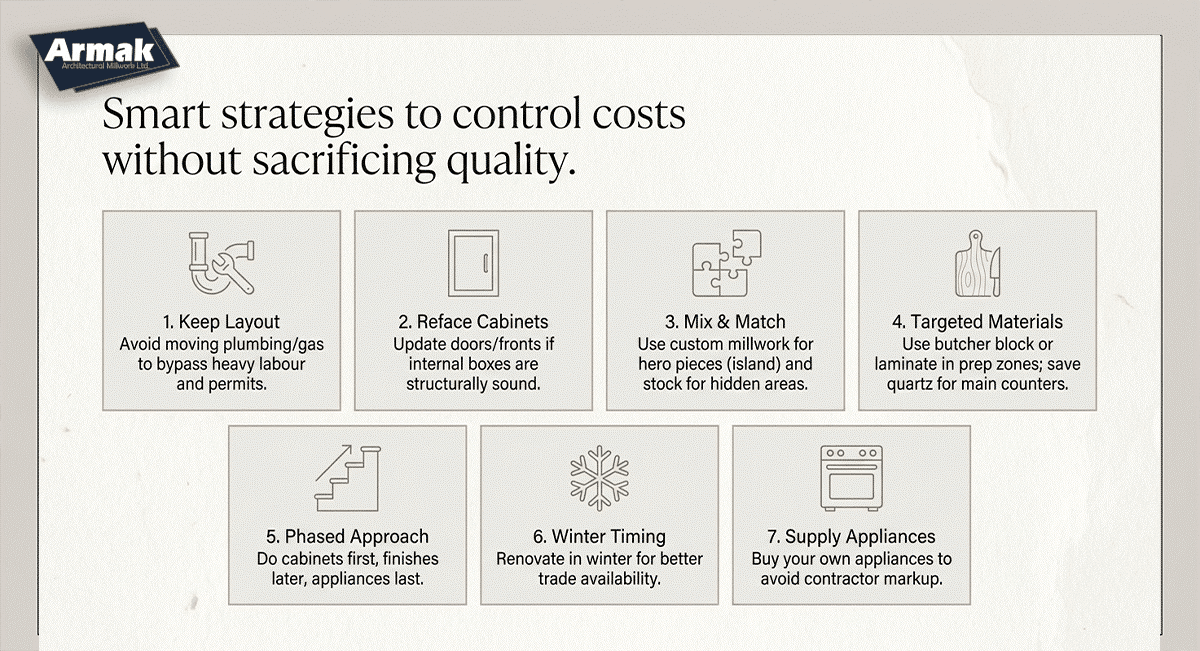
Reducing Kitchen Renovation Cost in Vancouver is not about cutting corners, but about making smarter design and material decisions. With the right planning, you can control the budget while still achieving a high-quality result.
1. Keep the Existing Layout
One of the most effective cost-saving strategies is to avoid moving plumbing, gas lines, or electrical points. Keeping the original layout significantly reduces labour complexity and permit requirements.
2. Cabinet Refacing vs. Full Replacement
- Refacing: New doors and fronts while keeping cabinet boxes
- Replacement: Full removal and new installation
Refacing is often a strong option when the existing structure is still solid and can reduce costs by a noticeable margin without major visual compromise.
3. Mix Custom Millwork with Stock Solutions
Not every part of the kitchen needs full customization. A practical approach is:
- Custom millwork for key focal points (island, pantry wall)
- Stock or semi-custom cabinets in less visible areas
This balance helps control cost while still achieving a premium look where it matters most.
4. Quartz Alternatives
Quartz is popular in Vancouver, but not always necessary in every zone of the kitchen. Alternatives like laminate or butcher block can be used in secondary areas such as prep stations or utility sections to reduce overall material cost.
5. Phased Renovation Approach
Instead of completing everything at once, some homeowners divide the project into stages:
- Phase 1: cabinetry and layout
- Phase 2: countertops and finishes
- Phase 3: appliances and detailing
This spreads cost over time and reduces financial pressure.
6. Smart Timing Strategy
Renovation timing can also impact cost and availability. Winter months are often more flexible, with better contractor availability and fewer scheduling delays, while spring and summer tend to be peak seasons with higher demand and tighter timelines.
7. Supply Your Own Appliances
Purchasing appliances directly can sometimes reduce markup costs from contractors. It also gives more control over brands, features, and budget allocation, especially in mid to high-range projects where appliance selection is a major cost factor.
ROI of Kitchen Renovation Cost in Vancouver
The return on investment (ROI) of a Kitchen Renovation Cost in Vancouver depends heavily on the renovation tier, property location, and overall market positioning. Not all upgrades deliver the same financial return, so aligning the renovation scope with your property value is critical.
ROI by Renovation Tier
- Budget → Rental optimization Improves functionality and tenant appeal, but limited resale uplift.
- Mid-Range → Highest resale ROI Best balance of cost and market appeal, especially in most Vancouver neighbourhoods.
- High-End → Lifestyle-driven value Strong impact on daily living, but financial return is more dependent on neighbourhood ceiling.
Neighbourhood Price Matching Matters
One of the most important factors in Vancouver is matching renovation level to local property values. Over-renovating in a lower or mid-market area often leads to weak ROI because buyers are not willing to pay a premium beyond the neighbourhood standard. In contrast, well-executed mid-range kitchens in strong resale areas tend to perform best because they meet buyer expectations without pushing beyond what the market can absorb.
Conclusion
Kitchen Renovation Cost in Vancouverr vary widely depending on scope, materials, and level of customization, ranging from simple budget updates to fully custom high-end remodels. While budget renovations focus on basic upgrades and rental efficiency, mid-range projects typically offer the strongest balance of cost and resale value for most homeowners. High-end kitchens, on the other hand, prioritize design, lifestyle, and custom millwork, but their financial return is more dependent on neighbourhood limits. Ultimately, choosing the right approach comes down to aligning your renovation level with property value, long-term goals, and realistic expectations of the Vancouver market.


