


Permit costs are one of the most overlooked line items in any renovation budget, and in Metro Vancouver, they can range from a flat $100 fee to several thousand dollars depending on the scope of your project and the city you’re in. Whether you’re planning a kitchen update, finishing a basement, or adding a suite, knowing what to expect upfront helps you plan smarter and avoid surprises mid-project. At Armak Millwork, we’ve worked with homeowners across Metro Vancouver on renovations of all sizes, and we’re here to help you navigate both the costs and the process, from permits to the final finish.
How Much Do Home Renovation Permits Cost in Metro Vancouver?
In most Metro Vancouver municipalities, residential renovation permits fall somewhere between $150 and $5,000+. The exact number depends on three main factors: what type of work you’re doing, how much the project is worth, and which city you’re filing in. Here’s a general snapshot to give you a starting point:
| Renovation Type | Typical Permit Cost Range |
|---|---|
| Minor plumbing or electrical | $100-$300 |
| Kitchen renovation | $200-$600+ |
| Bathroom renovation | $1,000-$3,000+ |
| Basement finishing / suite conversion | $1,000-$3,000+ |
| Home addition or second storey | $1,500-$5,000+ |
| Deck or laneway home | $500-$2,500+ |
Keep in mind that these figures cover the permit application itself. Inspection fees, engineering drawings, and other requirements can push the total higher, which we break down in a later section. Most municipalities calculate fees as a percentage of the declared construction value, typically between 1% and 1.5%. So a $60,000-dollar kitchen renovation in Burnaby, for example, might carry a permit fee around $600 to $900 before any additional charges. If your project involves structural changes, adding livable square footage, or converting space into a legal suite, expect to land on the higher end of these ranges regardless of which city you’re in.
Do You Always Need a Permit? (Quick Checklist)
Not every renovation in Metro Vancouver requires a permit, but more projects do than most homeowners expect. The general rule: if the work affects the structure, safety systems, or livable square footage of your home, a permit is required. Cosmetic updates typically don’t. You likely need a permit for:
- Removing or altering a load-bearing wall
- Adding or relocating plumbing (new sink, toilet, or shower)
- Electrical work beyond simple fixture swaps (panel upgrades, new circuits)
- Finishing a basement or converting it to a legal suite
- Building a deck over 24 inches from grade
- Adding a room, storey, or laneway home
- Installing a new HVAC system or gas line
- Replacing windows if the opening size changes
You typically don’t need a permit for:
- Painting, wallpaper, or interior trim work
- Replacing flooring (hardwood, tile, carpet)
- Swapping out kitchen cabinets without moving plumbing
- Installing new countertops
- Like-for-like fixture replacements (same location, same size)
- Minor landscaping
When in doubt, check with your municipality. Each city in Metro Vancouver has its own building department, and the threshold for what requires a permit can vary. A quick call or online inquiry before you start can save you from a stop-work order later. 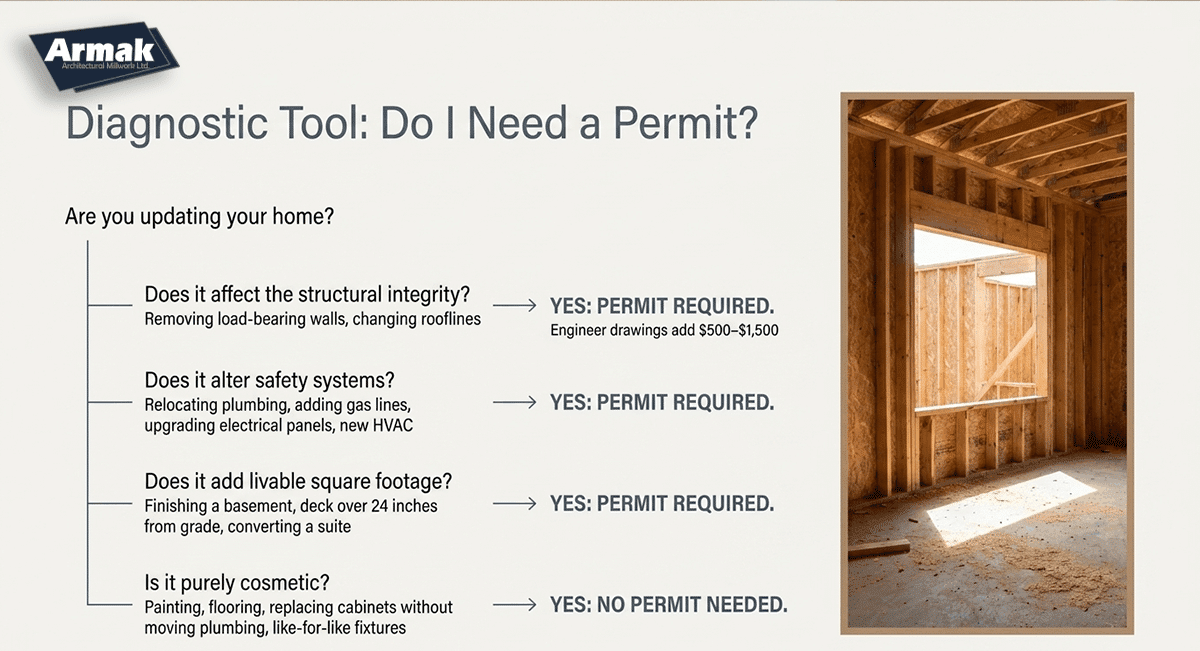
How Are Permit Fees Calculated in Metro Vancouver?
Most municipalities base their fees on a combination of your project’s declared value, the scope of work, and your location. Here’s how each factor affects what you’ll pay.
Project Value (Sliding Scale)
The most common method is a percentage of your declared construction value, typically between 1% and 1.5%.
| Declared Project Value | Estimated Permit Fee (at 1–1.5%) |
|---|---|
| $20,000 | $200 – $300 |
| $50,000 | $500 – $750 |
| $100,000 | $1,000 – $1,500 |
| $200,000 | $2,000 – $3,000 |
Some cities use a tiered scale where the rate drops slightly for higher-value projects. Others apply a flat minimum for smaller jobs. Important: underreporting your project value to reduce fees is considered fraud and can cause serious issues during inspections or resale.
Scope and Structural Changes
Once your project involves structural work, the permit category and the fee goes up. Work that triggers higher fees includes:
- Removing or altering load-bearing walls
- Relocating plumbing or electrical panels
- Changing the roofline or building envelope
- Converting unfinished space into livable area
More trades involved (structural, mechanical, electrical, plumbing) can mean multiple separate permits, each with its own fee.
Municipality You’re In
Each city in Metro Vancouver sets its own fee schedule. The same basement suite conversion can cost significantly more in permit fees in Vancouver than in Port Coquitlam, not because the work differs, but because the formulas do. We break this down city by city in the next section.
Secondary Suites and Basement Conversions
Suites are treated as separate dwelling units, which means additional review, inspections, and sometimes Development Cost Charges (DCCs). Permit fees for a legal secondary suite typically range from $1,500 to $4,000+ depending on the city and whether the suite is new or being legalized after the fact. If you’re adding a suite for rental income, factor permit and inspection costs into your ROI calculation from the start.
Permit Costs by Renovation Type
Permit fees vary significantly depending on what you’re building or changing. Below is a breakdown by the most common residential renovation types in Metro Vancouver.
Kitchen Renovation Permit Costs
A basic kitchen refresh, new cabinets, countertops, flooring, typically doesn’t require a permit. But if your renovation involves moving plumbing, relocating electrical panels, or altering walls, you’ll need one. Typical permit cost: $300–$900 What triggers a permit:
- Moving the sink or adding a gas line
- Upgrading electrical to meet current code
- Removing a wall (especially load-bearing)
If your kitchen reno stays cosmetic, you’re likely permit-free. When in doubt, call your city’s building department before starting.
Bathroom Renovation Permit Costs
Similar to kitchens, cosmetic bathroom work (tile, vanity, fixtures in the same location) usually doesn’t require a permit. Permits are required when plumbing is relocated, ventilation is added, or structural changes are made. Typical permit cost: $250–$800 What triggers a permit:
- Moving or adding plumbing rough-ins
- Adding a bathroom where none existed
- Installing a new exhaust fan tied to electrical
Adding a brand-new bathroom to your home sits in a higher fee range, closer to $800–$2,000 depending on scope and city.
Basement Renovation & Legal Suite Permit Costs
This is one of the most permit-intensive renovation types. Converting an unfinished basement into livable space, or legalizing an existing suite, requires building, plumbing, electrical, and sometimes mechanical permits. Typical permit cost: 1,500–4,500+
| Scope | Estimated Permit Cost |
|---|---|
| Finishing basement (no suite) | $800–$2,000 |
| New legal secondary suite | $1,500–$4,000 |
| Legalizing existing suite | $1,200–$3,500 |
Costs vary widely by city. Vancouver and Burnaby tend to be on the higher end; cities like Maple Ridge or Langley are generally lower.
Load-Bearing Wall Removal
Removing a load-bearing wall always requires a permit, no exceptions. The city needs to verify that the structural replacement (typically a beam and posts) meets code before and after the work. Typical permit cost: $400–$1,200 You’ll also need engineer-stamped drawings in most cases, which adds $500–$1,500 to your total project cost outside of the permit fee itself.
Home Addition Permit Costs
Adding square footage to your home, whether a new room, a second storey, or an attached garage, is one of the more complex permit applications. It involves building, structural, electrical, and sometimes plumbing permits, plus zoning review. Typical permit cost: $2,000–$8,000+ Fee is calculated based on the addition’s construction value, typically at 1% to 1.5%. A $300,000 dollar addition in Vancouver could carry permit fees of $3,000 to $4,500 before any additional charges. Larger additions may also trigger Development Cost Charges (DCCs) and school site acquisition charges depending on the municipality.
Deck & Laneway Home Permits
Decks:
Decks over 24 inches above grade require a permit in most Metro Vancouver cities. The fee is modest compared to interior work. Typical permit cost: $200–$600
Laneway Homes:
Laneway homes are treated as new residential construction and carry the highest permit fees of any renovation category. Typical permit cost: $8,000–$20,000+ This includes building, plumbing, electrical, and mechanical permits, plus potential DCCs and utility connection fees. In the City of Vancouver, total permit and development fees for a laneway home can exceed $25,000 depending on size and lot location.
Permit Costs in the City of Vancouver: How the Fee Structure Works
Vancouver uses a tiered fee schedule based on your declared construction value, not a flat rate. The higher the project value, the higher the fee, though the effective percentage tends to drop slightly as values increase. For a $150,000 renovation, the building permit fee works out to roughly $921, including the base rate and a standard issuance fee. Add plumbing and electrical permits, and total permit costs for a mid-range project typically land between $1,400 and $2,200, which is about 0.9% to 1.5% of project value. Here’s how that looks across different project sizes:
| Declared Construction Value | Estimated Building Permit Fee |
|---|---|
| $50,000 | $350 – $500 |
| $100,000 | $600 – $900 |
| $150,000 | $900 – $1,000 |
| $250,000 | $1,400 – $1,800 |
| $500,000 | $2,500 – $3,500 |
Two things that set Vancouver apart from surrounding cities: Development Cost Levies (DCLs) apply to any project that adds new habitable floor area, including additions, secondary suites, and laneway homes. Rates range from $12 to $30+ per square foot depending on your zone. Standard renovations within the existing footprint are exempt. Processing times are longer than most Metro Vancouver municipalities. Standard residential applications take 4 to 10 weeks. Projects involving heritage properties, rezoning, or complex structural work can take considerably longer. Fees across all permit categories increased 4.5% for 2026.
Permit Costs by Municipality | City-by-City Breakdown
Permit fees across Metro Vancouver are not standardized. Each municipality sets its own fee schedule, and the difference between cities can add up to hundreds, sometimes thousands, of dollars on the same project. Here is what homeowners can expect in each area. 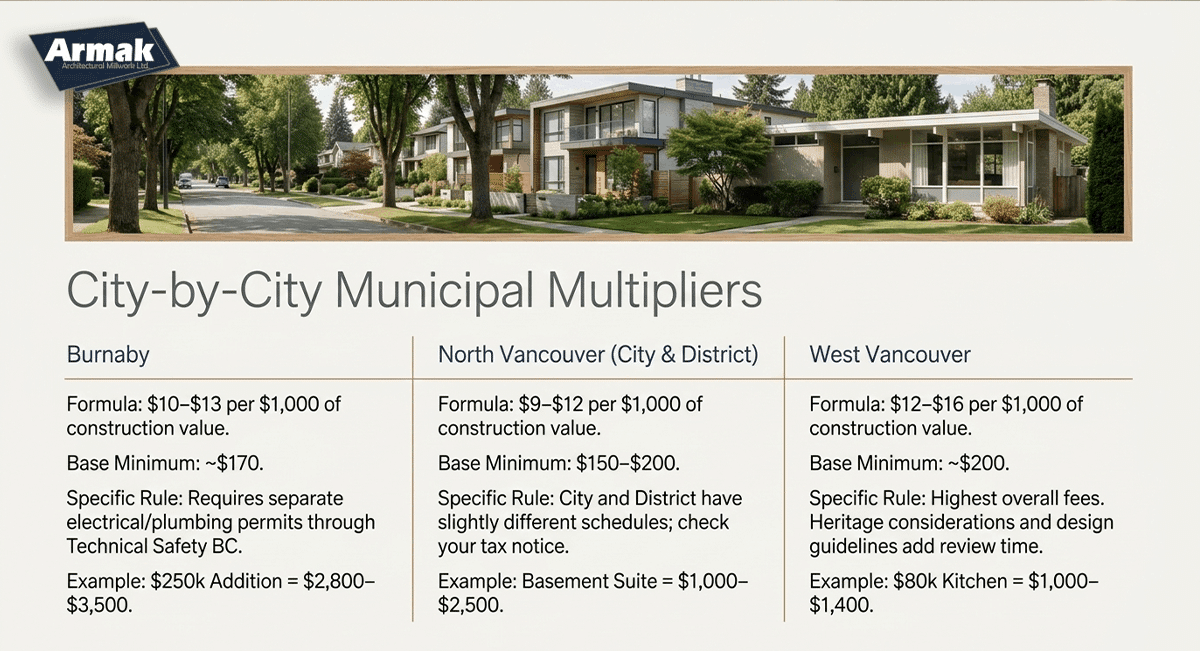
City of Vancouver
Vancouver uses a construction value-based permit system. Most residential renovation permits start around $190, with additional fees typically based on the project’s declared value.
- Kitchen renovation ($60,000 project): $600 – $900
- Home addition ($300,000 project): $3,000 – $4,500+
Separate plumbing, electrical, and mechanical permits may add to the total cost.
Burnaby
Burnaby calculates permit fees based on construction value using a tiered rate structure. Fees generally range between $10 and $13 per $1,000 of construction value, with a minimum permit fee of around $170. Typical ranges for common projects:
| Project | Estimated Permit Fee |
|---|---|
| Kitchen renovation ($50,000) | $550–$750 |
| Bathroom renovation ($25,000) | $300–$450 |
| Basement suite conversion | $1,200–$3,000 |
| Home addition ($250,000) | $2,800–$3,500 |
Burnaby also requires separate electrical and plumbing permits through BC Safety Authority (Technical Safety BC), which adds to the overall cost.
North Vancouver
North Vancouver (both the District and the City) follows a similar value-based permit model. Fees are typically calculated at $9 to $12 per $1,000 of construction value, with minimum permit fees starting around $150 to $200, depending on the project type. One distinction here: the District of North Vancouver and the City of North Vancouver are separate municipalities with slightly different fee schedules. If you are unsure which jurisdiction your property falls under, check your property tax notice. Typical permit costs:
- Kitchen or bathroom renovation: $250–$700
- Basement suite: $1,000–$2,500
- Home addition: $2,000–$5,000+
West Vancouver
West Vancouver consistently has some of the highest permit fees in Metro Vancouver, reflecting both property values and the municipality’s fee structure. Fees are typically calculated at around $12 to $16 per $1,000 of construction value, with minimum permit fees starting near $200. Given that renovation projects in West Vancouver often involve higher construction values, permit costs can climb quickly:
- Kitchen renovation ($80,000 project): $1,000 – $1,400
- Bathroom renovation ($35,000 project): $450 – $600
- Home addition ($400,000 project): $5,000 – $7,000+
- Secondary suite or coach house: $2,500–$5,000+
West Vancouver also has specific design guidelines and heritage considerations in certain neighbourhoods that can add review time and associated fees.
What Happens If You Renovate Without a Permit?
Skipping a permit might seem like a way to save money at the start of a renovation, but in Metro Vancouver it often leads to higher costs later. Municipalities actively monitor unpermitted work, especially when it involves structural changes, suites, or major systems like plumbing and electrical. What looks like a short-term saving can quickly turn into unexpected expenses and delays.
Stop-Work Orders
If the city discovers work being done without the required permit, they can issue a stop-work order immediately. This means all construction must pause until the proper permits are obtained and inspections are scheduled. In practice, this usually leads to:
- Idle contractors still charging for time or rescheduling
- Project delays that can last weeks or months
- Additional fees for re-application or revised drawings
The financial impact often goes beyond the original permit cost, especially if construction has to be partially undone to meet code requirements.
Fines and Penalties
Unpermitted work can result in municipal fines and enforcement charges, which vary depending on the type and scale of the violation. In addition to penalties, homeowners are often required to apply for retroactive permits and cover additional engineering or inspection costs, making the total expense significantly higher than obtaining a permit from the start.
Problems When Selling Your Home
Unpermitted renovations can become a major issue during resale. Home inspectors and buyers often flag missing permits, especially for basements, kitchens, and structural changes. This can lead to:
- Reduced property value during negotiation
- Requirement to legalize work before closing
- Deal delays or collapsed sales
In some cases, sellers are forced to pay for retroactive permits and upgrades just to complete the transaction, which can be far more expensive than the original permit fees.
Insurance Voidance
Insurance coverage can be affected if damage occurs in areas that were renovated without proper permits. Many insurers require compliance with local building codes, and claims related to unapproved work such as electrical, plumbing, or structural changes may be denied, leaving homeowners responsible for potentially significant repair costs. 
How to Reduce Permit Costs Without Cutting Corners?
Reducing permit costs is mostly about smarter planning, not avoiding rules. In Metro Vancouver, most extra expenses come from revisions, delays, or unclear project scope rather than the base permit fee itself.
- Define the full project scope before applying
- A clear and complete plan reduces revisions from the city. Fewer revisions usually means fewer delays and lower indirect costs like redesign or re-submission fees.
- Avoid unnecessary structural changes
- Keeping layouts as close to existing conditions as possible can reduce engineering requirements and simplify the permit process, which often lowers overall costs.
- Keep plumbing and electrical in the same locations when possible
- Moving sinks, bathrooms, or electrical panels usually increases permit complexity and may require additional trade permits and inspections.
- Work with experienced local professionals
- Designers and contractors familiar with Metro Vancouver municipalities can help prevent common mistakes that lead to re-submissions or approval delays.
- Submit complete and accurate drawings from the start
- Missing or unclear documentation is one of the main reasons permits get delayed or require additional review fees.
- Plan timing carefully
- Some municipalities update fee schedules periodically. Submitting before changes or peak seasons can help avoid small cost increases and processing delays.
- Use a realistic construction budget for permit valuation
- Under-declaring project value can lead to corrections, penalties, or re-assessments that ultimately cost more than the original savings.
- Separate cosmetic and structural work where possible
- Doing non-structural upgrades without altering systems or layouts can sometimes reduce the need for full building permits or multiple trade permits.
Conclusion
Permit costs in Metro Vancouver vary significantly depending on the municipality, project type, and declared construction value, with most residential renovations falling somewhere between a few hundred dollars for minor work and several thousand dollars for larger additions or secondary suites. While each city has its own fee structure, the biggest cost drivers are typically structural changes, new livable space, and added trade permits for plumbing, electrical, or mechanical systems. Understanding these factors in advance helps homeowners plan more accurately, avoid unexpected expenses, and ensure their renovation stays compliant with local building regulations from start to finish.


