


Most homes in Metro Vancouver built before the 1990s were designed around a way of living that no longer fits how families actually use their space today. Separate rooms, closed-off kitchens, and disconnected layouts made sense for a different era. They don’t anymore. An Open Concept Renovation in Metro Vancouver changes not just how a home looks, but how it functions day to day. Done right, it adds real value and makes the home genuinely easier to live in. Done without proper planning, it creates structural and permit problems that cost far more to fix than the renovation itself. As one of the most impactful home renovation decisions you can make in an older Metro Vancouver property, this guide covers everything you need to know before the first wall comes down.
What Is an Open Concept Renovation in Metro Vancouver? (And What It Isn’t)
An open concept renovation means removing walls that separate the kitchen, dining, and living areas to create one connected, flowing space. In Metro Vancouver homes, this typically involves one or more interior walls on the main floor, and in some cases, partial wall removal to define zones without fully closing them off. The goal is better light, better sightlines, and a layout that actually matches how people live.
That said, there’s a common misconception worth clearing up. Open Concept Renovation in Metro Vancouver doesn’t mean removing every interior wall or eliminating all sense of structure. It means making intentional choices about which barriers to remove and which to keep, based on both function and structure.
What an open concept renovation typically includes:
- Removing one or more interior walls between the kitchen, dining room, or living room
- Installing a structural beam where a load-bearing wall once stood
- Relocating or upgrading electrical, plumbing, or HVAC lines that ran through removed walls
- Refinishing floors to create a seamless, unified surface across the new open space
What it does not include:
- Removing exterior walls or walls that define separate bedrooms or bathrooms
- Simply redecorating or rearranging furniture
- Partial cosmetic changes like widening a doorway, which is a different scope entirely
Is Your Wall Load-Bearing? The Most Important Question First
Before any Open Concept Renovation in Metro Vancouver gets priced, permitted, or planned, one question has to be answered first: is the wall you want to remove actually holding something up?
A load-bearing wall carries the weight of the structure above and transfers that load down to the foundation. Removing one without proper support can compromise the entire home’s structural integrity. Several factors help identify whether a wall is load-bearing:
| Indicator | What It Suggests |
|---|---|
| Wall runs perpendicular to floor joists | Likely load-bearing |
| Wall sits directly above a beam or foundation | Strong indicator |
| Wall near the center of the home | Often load-bearing |
| Wall runs parallel to joists, nothing above | Likely non-load-bearing |
Even with these indicators, visual inspection alone isn’t reliable. Older Metro Vancouver homes often have non-standard framing that doesn’t follow predictable patterns. A structural engineer’s assessment is the only definitive answer, and in most municipalities it’s also required before a building permit is issued for wall removal.
If the wall is load-bearing, it can still come down. It just needs a properly engineered beam installed in its place, sized based on the span and load conditions specific to your home.
Open Concept Renovation Costs in Metro Vancouver (2026)
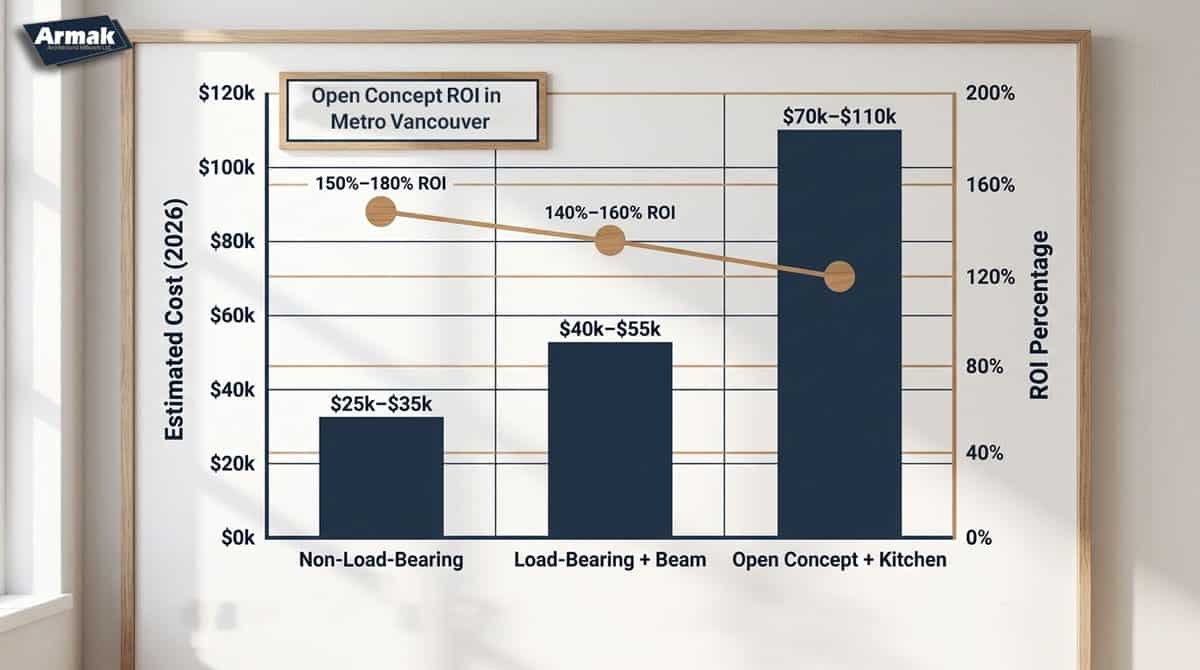
Pricing for an Open Concept Renovation in Metro Vancouver varies significantly based on one key variable: whether or not a load-bearing wall is involved.
A straightforward non-load-bearing wall removal between a kitchen and living room, including floor refinishing and repainting, typically runs $25,000 to $35,000. Where load-bearing walls are involved, that range rises to $40,000 to $55,000 to account for structural engineering, beam installation, and permits.
For a full main floor Open Concept Renovation in Metro Vancouver transformation that combines the kitchen, dining, and living areas, the numbers are higher:
| Scope | Estimated Cost (2026) |
|---|---|
| Non-load-bearing wall removal + finishing | $25,000 – $35,000 |
| Load-bearing wall removal + beam + finishing | $40,000 – $55,000 |
| Full main floor open concept (kitchen + living + dining) | $95,000 – $160,000 |
| Open concept + kitchen refresh combined | $70,000 – $110,000 |
What drives the cost up:
- Electrical or plumbing lines running through the wall being removed
- HVAC ductwork that needs rerouting
- Floor patching where the wall once stood
- Asbestos abatement in pre-1990 homes, which is a WorkSafeBC requirement before demolition
Permits and engineering fees are separate from contractor costs.
Building permits in Metro Vancouver typically range from $500 to $2,500, with an additional $2,000 to $5,000 for engineering reports, drawings, and inspections. Home renovation permit costs in Metro Vancouver vary by municipality and project scope, so it’s worth understanding what applies to your specific city before submitting.
One practical note: for any home built before 1990, carry a 15% contingency on top of your quoted budget. Older homes regularly reveal surprises once walls are opened, from outdated wiring to moisture damage, and having that buffer prevents the project from stalling mid-construction.
The Step-by-Step Process: From Idea to Open Floor Plan
Most Open Concept Renovation in Metro Vancouver don’t fail during construction. They fail during planning, or more accurately, because of the lack of it. Understanding the sequence of steps before work begins is what separates a smooth project from one that runs over budget and over schedule.
- Step 1: Structural Assessment: Before any design decisions are made, a structural engineer needs to evaluate the walls you want to remove. This determines what’s load-bearing, what beam sizing is required, and what the permit drawings need to reflect. Skipping this step and discovering the issue on demo day is one of the most common and expensive mistakes in Open Concept Renovation in Metro Vancouver projects.
- Step 2: Design and Space Planning: Once the structural picture is clear, a designer or design-build contractor maps out the new layout. This includes ceiling height changes, kitchen island placement if applicable, lighting zones, and how flooring will flow across the new unified space. Good design at this stage prevents costly changes mid-construction.
- Step 3: Permit Application: Wall removal in Metro Vancouver requires a building permit in virtually all cases, especially when load-bearing walls are involved. Your contractor submits the permit application along with the engineer’s stamped drawings to the relevant municipality, whether that’s the City of Vancouver, Coquitlam, Burnaby, Surrey, or another. For homeowners in the Tri-Cities area, home renovation costs in Port Coquitlam follow their own permit and pricing structure worth reviewing separately. Approval timelines vary by municipality, so factoring this into your project schedule early is important.
- Step 4: Demolition and Rough-In Work: Once permits are approved and posted on site, demolition begins. After the wall comes down and the beam is installed, trades come in for rough-in work: electrical, plumbing, and HVAC are rerouted or upgraded as needed. This phase requires inspection before walls are closed up.
- Step 5: Finishing: With rough-in inspections passed, finishing work begins. Drywall, ceiling repairs, floor patching or full floor refinishing, painting, and trim work bring the space together. For Open Concept Renovation in Metro Vancouver that include a kitchen update, cabinetry and countertop installation happen during this phase.
- Step 6: Final Inspection and Sign-Off: A final inspection by the municipality confirms the work matches the permitted drawings. This sign-off is not just a formality. It protects your home’s value and ensures there are no complications when you eventually sell.
How Open Concept Renovation Affects Lighting, HVAC & Acoustics
Removing walls changes more than the look of a space. Three systems that worked fine in a closed layout often need to be reassessed.
Lighting
A single overhead fixture that worked in a small dining room becomes inadequate in a large open space. You’ll need a layered approach: recessed pot lights for general light, pendants over islands or dining areas, and under-cabinet lighting in the kitchen. On the upside, removing walls almost always brings in more natural light, which is one of the biggest benefits of this type of renovation.
HVAC
Older Metro Vancouver homes were ducted for individual rooms. Open those up and airflow patterns change. Sometimes existing ductwork handles the new layout fine. Other times, ducts need to be extended or redirected. This is worth assessing early because discovering it mid-project adds both cost and time.
Acoustics
This is the consideration most homeowners overlook until after the renovation. Walls absorb sound. Remove them, and noise from the kitchen travels freely into living and dining areas. Area rugs, upholstered furniture, and acoustic ceiling treatments help significantly. If your open space will sit adjacent to a home office or media room, build soundproofing into the scope from the start.
Open Concept ROI in Metro Vancouver: Is It Worth It?
For most Metro Vancouver homeowners, the short answer is yes, but the return depends on how the project is scoped and what the home’s baseline layout looks like.
A non-load-bearing wall removal that connects a kitchen and living area, with floor refinishing and repainting, consistently delivers strong returns. At a cost of $25,000 to $35,000, the perceived transformation for a buyer walking through the home is significant enough to justify the investment many times over. Where load-bearing walls are involved and costs rise to $40,000 to $55,000, the ROI remains solid because the value added scales with the visual and functional impact, not with the structural complexity behind it.
The numbers from current Metro Vancouver market data reflect this:
| Project Type | Estimated Cost | ROI Range |
|---|---|---|
| Non-load-bearing wall removal | $25,000 – $35,000 | 150% – 180% |
| Load-bearing wall removal + beam | $40,000 – $55,000 | 140% – 160% |
| Open concept + kitchen refresh | $70,000 – $110,000 | 120% – 160% |
The strongest returns come when an Open Concept Renovation in Metro Vancouver is combined with a simultaneous kitchen update, and understanding the kitchen renovation cost in Vancouver separately helps you allocate budget more accurately across both scopes. Buyers respond to the combination of connected space and a refreshed kitchen far more than to either change on its own.
One important caveat: over-renovating relative to the neighbourhood ceiling reduces ROI regardless of project quality. A $160,000 Open Concept Renovation in Metro Vancouver and kitchen overhaul in a market where comparable homes sell at a modest premium will not return what the same project delivers in a higher-value neighbourhood. Knowing your market before committing to scope is as important as the renovation itself.
Common Mistakes to Avoid in Open Concept Renovation in Metro Vancouver
Even well-intentioned Open Concept Renovation in Metro Vancouver go sideways when certain steps are skipped or underestimated. These are the mistakes that show up most consistently in Metro Vancouver projects.
- Assuming a wall is non-load-bearing without verification: This is the most costly mistake in any open concept project. Discovering a wall is structural on demo day means stopping work, bringing in an engineer, redesigning the beam specification, and reapplying for permits. The delay and added cost are entirely avoidable with a proper assessment upfront.
- Pulling permits late or not at all: Some homeowners try to avoid the permit process to save time or money. In Metro Vancouver, unpermitted structural work creates serious problems at resale. Buyers’ home inspectors flag it, lenders can refuse financing, and the municipality can require the work to be opened up and re-inspected at the homeowner’s expense.
- Not budgeting for what’s inside the wall: Electrical panels, plumbing lines, and HVAC ducts frequently run through the walls targeted for removal. These aren’t visible until demolition begins, which is why a 15% contingency on any pre-1990 home is not optional.
- Neglecting flooring continuity: Once a wall comes down, the floor where it stood needs to be patched or the entire surface refinished to read as one unified space. Homeowners who don’t plan for this end up with a visible seam running across the floor that undermines the entire renovation.
- Treating Open Concept Renovation in Metro Vancouver as a design-only decision: The structural, mechanical, and permit considerations are just as important as how the space will look. Engaging a contractor who handles design and construction together from the start prevents the gaps that occur when these responsibilities are split between parties who aren’t communicating properly.
Why Choose a Design-Build Contractor for Your Open Concept Project?
An Open Concept Renovation in Metro Vancouver involves structural decisions, permit applications, trade coordination, and finish work, all happening in sequence and all dependent on each other. When these responsibilities are split between a designer, a general contractor, and separate trades who don’t share the same information or timeline, the gaps between them are where most projects run into trouble.
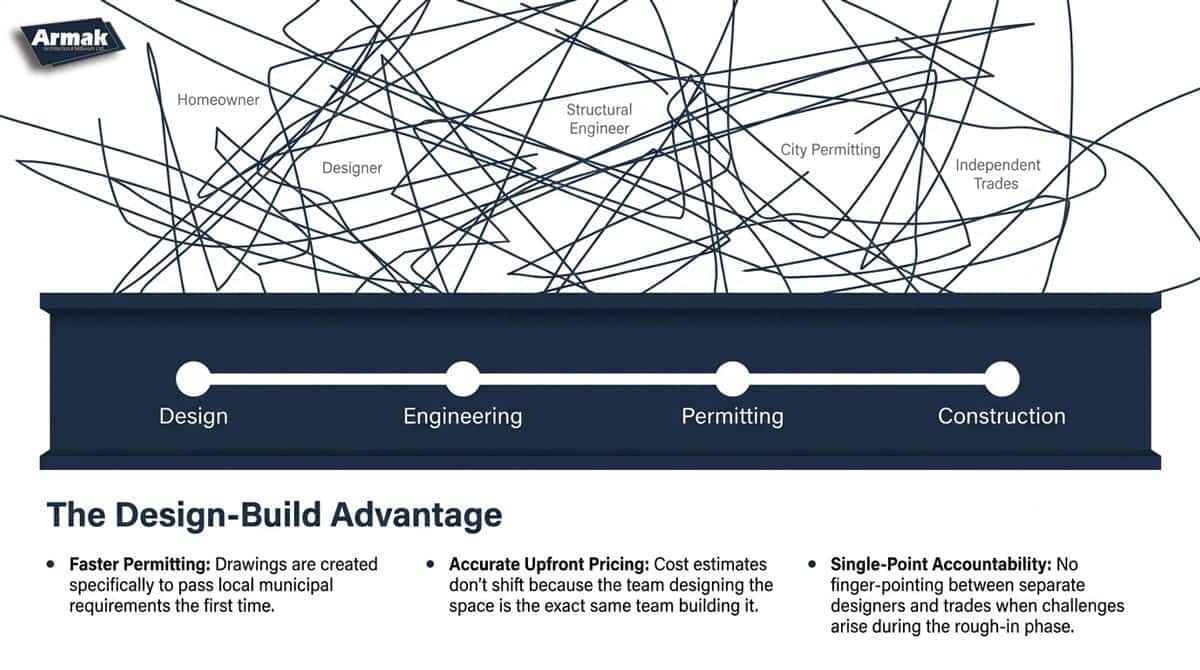
A design-build contractor handles the entire process under one roof. The structural assessment, layout planning, permit drawings, demolition, beam installation, trade rough-ins, and finishing work are all managed by the same team, with one point of contact and one accountable party from start to finish.
For homeowners in Metro Vancouver, this matters for a few practical reasons.
- Fewer handoff problems: In a traditional model, what the designer draws and what the contractor builds sometimes diverge because they’re not in constant communication. With a design-build approach, the person designing the space already knows what the construction team can execute, and the construction team is working from plans they helped develop. That alignment prevents the mid-project surprises that cause delays and cost overruns.
- Faster permit approvals: Because the structural engineer, designer, and contractor are working from the same set of documents, permit packages are submitted with fewer revisions. Municipalities like Burnaby, Coquitlam, and Surrey have specific requirements, and a contractor experienced in local permitting submits drawings that reflect those requirements from the start.
- Accurate upfront pricing: When design and construction are handled separately, cost estimates often shift once a contractor reviews the actual drawings. A design-build firm prices the project with full knowledge of the scope, so the number you receive early in the process holds up through construction.
- Accountability through every phase: If a problem surfaces during rough-in work, there’s no question about whose responsibility it is. The same team that designed the layout is responsible for resolving it. That continuity protects the homeowner from being caught in the middle of disputes between separate parties.
For an Open Concept Renovation in Metro Vancouver project specifically, where structural work, permits, and multiple trades all need to move in a coordinated sequence, having a single experienced team manage that process from the first conversation to the final inspection is not a convenience. It’s how the project gets done right.
Conclusion
An Open Concept Renovation in Metro Vancouver is one of the more meaningful changes you can make to an older home, but it’s also one that requires the right groundwork before anything gets demolished. Understanding whether your walls are load-bearing, knowing what permits are required, budgeting realistically for what’s inside the walls, and working with a contractor who manages the full scope from design through final inspection, these are what separate a project that adds lasting value from one that creates problems down the line. When it’s planned properly and executed by an experienced team, the result is a home that functions better, feels larger, and performs well in Metro Vancouver’s competitive real estate market.


